
Dreamsky Astrolab
The Science Behind Astromod
Astromodification Myth #1: Unlocking the Hidden Universe
Astromodification significantly improves a camera’s ability to capture the H-alpha (656.3nm) emission line, one of the most important wavelengths in nebula photography. By replacing the stock UV/IR cut filter with a dedicated BCF (Baader Conversion Filter), more nebular signal can reach the sensor, resulting in stronger detail, richer colors, and improved imaging efficiency.
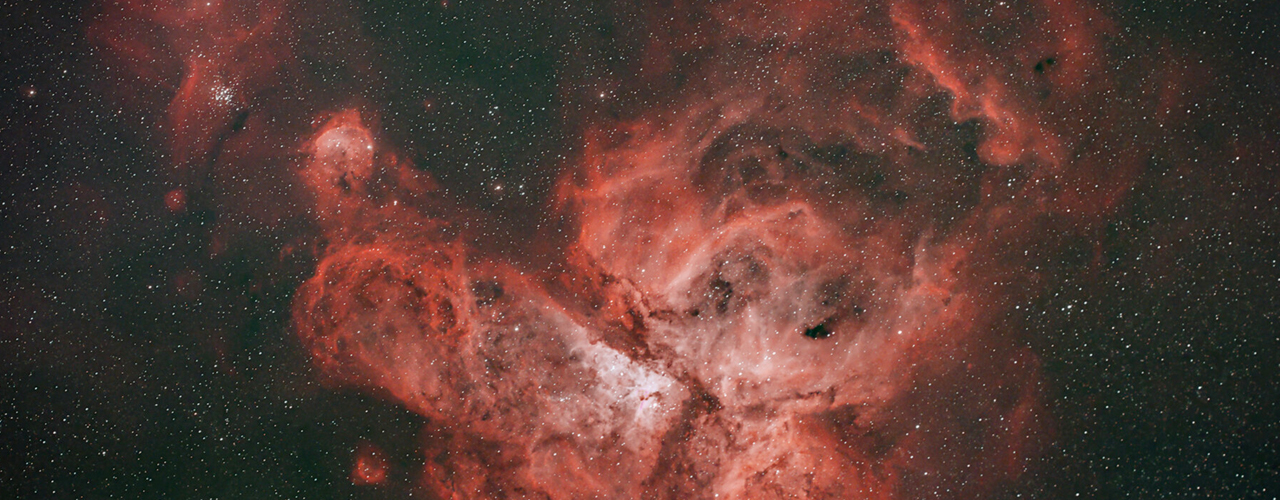
After astromodification, the camera can capture significantly more H-alpha light from deep space, revealing emission nebulae with greater clarity, richer color, and enhanced structural detail. The result is a noticeable improvement in nebular definition, color rendition, and the overall depth and visual impact of the image.
For astrophotography enthusiasts, astromodification represents more than a technical upgrade in image quality—it is a gateway to deep-sky exploration, revealing the hidden nebulae and cosmic structures that lie beyond the reach of standard imaging.


As shown above, the blue curve represents the transmission of the modified filter, while the red curve represents a stock DSLR filter. In the H-alpha emission band, the stock filter typically transmits only around 25% of the signal, whereas after astromodification, transmission can reach approximately 98%, significantly improving imaging efficiency.
In addition, since ultraviolet, visible, and infrared light have different refractive indices, the DS BCF Pro UV/IR cut filter helps minimize star bloat and maintain tighter, sharper star profiles.
Astromodification Myth #2: You Don’t Need Astromodification for Milky Way Astroscape
For casual photographers who mainly capture the Milky Way, star trails, or general nightscapes, astromodification is not strictly necessary. However, for astrophotographers seeking higher image quality and more detailed results, an astronomy camera or astromodified system can become an invaluable creative tool.
This is because when photographing emission nebulae, dust clouds, and other faint deep-sky objects, a standard camera has limited sensitivity to the H-alpha (Hydrogen-alpha) wavelength due to its factory-installed filter.Compared to an astromodified camera, stock camera typically requires several times more exposure time to accumulate the same level of astrophysical signal.
In other words, astromodification can significantly improve both imaging efficiency and final image quality. Otherwise, you would need to invest several times more exposure time, and even then, you may still not achieve the same level of detail and color response.

Stock Camera

Dreamsky Astromod
Astromodification Myth #3: Removing the IR Filter to Capture Infrared Light
In astrophotography, the commonly used BCF filter (UV/IR cut) is designed to allow high transmission of visible light within the 400–700nm range. In contrast, infrared modification (IR pass) follows a completely different approach, allowing near-infrared and infrared wavelengths to pass through.
As the names suggest, one is a UV/IR cut system, while the other is an IR pass system, where “IR” refers specifically to infrared light. It is important to clarify a common misconception: in astrophotography, we are still imaging in visible light. Removing the infrared cut filter is not intended to capture infrared images, but to improve the camera’s sensitivity to key deep-sky wavelengths within the visible spectrum.
Infrared modification (IR Pass) represents a completely different photographic approach. It allows near-infrared and infrared wavelengths to pass through, and is primarily used for infrared creative photography, rather than astrophotography.
The difference is clearly reflected in the filter names:
- UV/IR Cut: blocks ultraviolet and infrared light
- IR Pass: allows infrared light to pass through
Astrophotography is fundamentally based on visible light, and the purpose of removing or modifying filters is not to enable infrared imaging. In fact, UV/IR cut filtering is still important for controlling infrared contamination, producing tighter stars and cleaner images, while improving transmission of key emission lines such as H-alpha.In other words, the core goal of astromodification is to optimize a camera’s ability to capture visible-light signals from the universe—not to turn it into an infrared camera.


Astromodification Myth #4: A low-pass filter is not the same as a UV/IR cut filter.
Many discussions about astromodification mistakenly confuse the low-pass filter (Anti-Aliasing Filter) with the UV/IR cut filter, but they serve completely different purposes.In most digital cameras, the sensor is actually covered by a multi-layer optical stack, which may include a low-pass filter, a UV/IR cut filter, as well as protective and dust-reduction glass elements.
The function of the low-pass filter is to slightly blur the image in order to reduce moiré and aliasing effects, helping conventional photography produce more natural and stable-looking images. Moiré is an irregular pattern of colored stripes or waves caused by interference between high-frequency image detail and the pixel grid of the sensor.
Although modern high-resolution cameras are less prone to visible moiré, low-pass filters are still used to reduce the likelihood of such artifacts. However, this comes at the cost of slightly reduced image sharpness and fine detail resolution, which can also have a minor impact on star point sharpness in astrophotography.


DreamSky AstroLab Astromodification Services